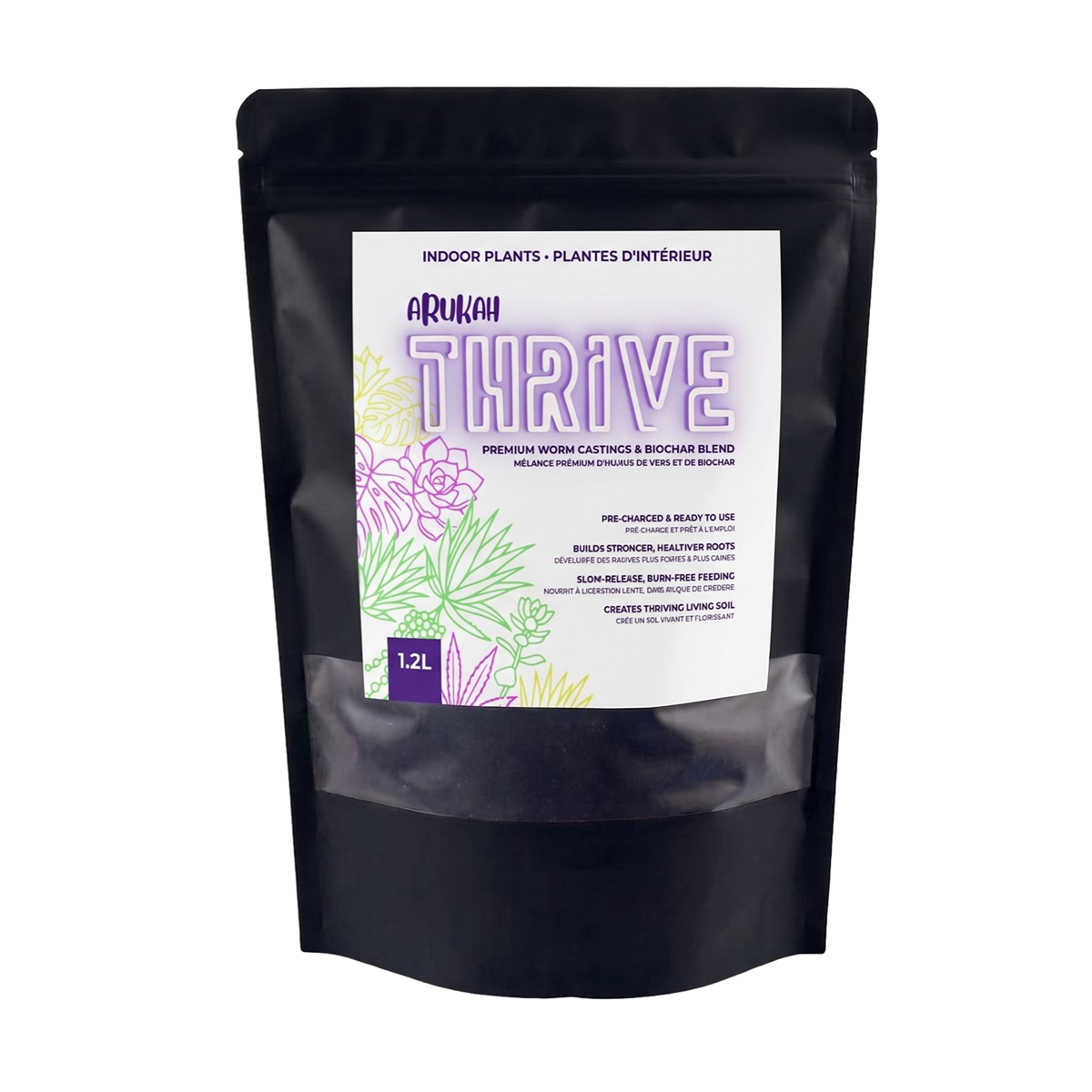
Your Plant Isn't Dying. Its Soil Is.
Living worm castings and biochar. Feeds the plant, rebuilds the soil.
Tired, stalled, yellowing houseplants?
-
Skip Repotting
Shop Thrive
Sprinkle a 1/4 cup around the base of the stem. Water as usual. Most plants won't need repotting.
$25 · Free shipping over $70 -
Odour-Free
Smells like clean earth, never like waste. -
Family Friendly
No synthetic fertilizers. Safe to use around pets and children as directed.
Plant care shouldn't feel like chemistry.
Whether you're top-dressing existing soil or giving a rootbound plant a fresh start in a new pot, Arukah Thrive makes it simple.
For most houseplants, no repotting is required. Sprinkle our hand-harvested living biology and biochar onto your soil and water as usual. For rootbound or severely stalled plants, mix it into fresh potting soil when you repot.
Three Steps. That's It.
-
1. Top-Dress (or Mix)
Sprinkle 1/4 cup onto your topsoil, or blend into fresh potting soil if repotting. -
2. Water
Water as usual to activate the living microbiology and biochar nutrient matrix. -
3. Watch It Thrive
Fresh leaves, stronger roots, active growth — usually within a few weeks.
What plant owners across Canada are saying
-
William H ~ Ottawa, On
We've been using the worm castings for about a year, and the results have been amazing. Our cactus, which had never bloomed before, flowered again this year, and our indoor plants are thriving.
Highly recommending Arukah worm castings for anyone looking to give their plants a real boost! -
Heather W ~ Montreal, Qc
I started my seedlings indoors this year (as per usual) however, I used Arukah worm castings mixed into my soil (squash, melon, and beans), expecting the usual slow start while waiting for warmer weather.
To my surprise, within a week and a half, I already had strong stems and two healthy leaves. The growth was noticeably faster and more robust than previous years.
I’ve now transplanted them into my garden feeling confident in their strength, and I’m already starting a second batch.
I'm impressed and pleasantly surprised with the results and excited to see what this season brings. -
Angela W ~ Cornwall, On
I'm not a green thumb, but I wish I was. My hanging pots were struggling in the soil they came in. I added some Arukah worm castings and within a few days the colour deepened and the flowers woke up.
I'm thrilled with the results and will definitely use it for life!
Arukah Worm Farm
Arukah Thrive (1.2L)
Free shipping on orders over $70 · Ships from our Ontario farm in 1–2 days
Share

Made by hand on a family farm in Newington, Ontario
We're a small family operation. Every batch of Arukah Thrive is harvested, screened, and blended by us — not bought in bulk and rebagged.
Arukah Worm Farm is proudly Indigenous-owned and a member of the Canadian Council for Indigenous Business.
Questions, answered
Is this the same as compost?
No. Compost is decomposed plant matter. Castings are that material after it's passed through a worm's digestive system, which concentrates nutrients and adds microbiology compost doesn't carry. They do different jobs and work well together.
Does it smell?
No. Fresh castings smell like clean earth, which is the sign of a healthy, aerobic product. Anything that smells like ammonia or waste has gone anaerobic or was made from manure feedstock. Ours is neither.
Is it safe around pets and kids?
Yes. No synthetic fertilizers, no pesticides, nothing but castings and biochar.
Is it organic?
Both ingredients are permitted in organic growing and neither requires registration under the Fertilizers Act.
How often do I use it?
Every 4 to 6 weeks for most houseplants. Stretch it toward 6 weeks in winter when growth slows, and pull it in toward 4 during the active growing season. Succulents and cacti need it less often. Twice a year is plenty.
Do I have to repot my plant?
No. Top-dress instead: sprinkle it on the soil surface and water it in. Repotting is only necessary if the plant is already rootbound and due for it, in which case mix the castings into the fresh soil while you're there.
Can I use too much?
Practically speaking, no. Castings release slowly and won't burn roots the way synthetic fertilizer will. Over-applying wastes product rather than harming the plant.
Do I still need to fertilize?
For most houseplants, castings cover it. Heavy feeders and fruiting plants may want a supplement during active growth.
How long does it keep?
Sealed and kept slightly moist, they hold their biology for roughly six months to a year. They don't spoil the way a fertilizer expires, since the nutrients stay put regardless, but the living microbiology is what makes castings work and that fades as the material dries out. Store the bag closed, out of direct sun, somewhere that doesn't freeze or bake.
Can I still use my castings after the season?
Yes. The living microbiology in castings is highest when fresh and declines as the material dries and ages, and adding water later won't bring it back. But the part that does most of the heavy lifting for plant growth is stable: the humic acids, the slow-release nutrients, the trace minerals, and the natural plant growth compounds are all still in there. Older castings are still a genuinely good soil amendment. Use them, just use your freshest bag when you want maximum biological activity.
Why does biochar need to be "charged"?
Raw biochar is empty and will pull nutrients out of your soil at first. Ours is pre-charged in the castings, so it arrives loaded and ready to work.
Does biochar raise soil pH?
Slightly alkaline, yes, but the amounts here are small enough not to matter for typical houseplants. Acid-lovers like blueberries or azaleas are the exception worth watching.